

Yours truly has just raised the premium on his life insurance, because there can be nasty consequences when you criticize an album that has been put on a pedestal for a very long time. On the other hand, I am not actually out to provoke, as I’ve had the same opinion about Sgt. Pepper’s Lonely Hearts Club Band for many years.
This article has no other intentions than the best, which is fulfilled by adding a somewhat nonconformist viewpoint to otherwise abundant tributes.
A recurring theme is the divergence between the album’s perceived enormous impact on rock history and its groundbreaking studio production on the one hand, and the qualities of the individual songs on the other. In my opinion, this tension becomes clear when a thorough song-by-song evaluation is made.
I will also illustrate how the album most likely changed the music scene once and for all.
But before we continue the review and dissect of Sgt. Pepper, let’s go back to 1966–1967 and examine the pop scene.
 During the first months of 1967, the album was becoming increasingly important, something that both the debut with The Doors and the first successful psychedelic album (Surrealistic Pillow) with Jefferson Airplane underlined. Additionally, after three singles that had guitar heroes gasping for breath, Jimi Hendrix fell into line with his debut album Are You Experienced?, released just three weeks before Sgt. Pepper. Paul McCartney also cites The Mothers of Invention’s double LP Freak Out! (released in June 1966) as an inspiration.
On the domestic front, The Beatles’ fiercest competitor, The Rolling Stones, continued to deliver strong singles, such as Have You Seen Your Mother, Baby, Standing in the Shadow? and Let’s Spend the Night Together / Ruby Tuesday, as well as the full-fledged album, Between the Buttons. Other British bands, such as The Hollies, The Kinks and Manfred Mann, continued to deliver Top 5 singles, but the first two groups had also begun to use the album format successfully.
Then there was a guy in California named Brian Wilson. After the album Pet Sounds and the single Good Vibrations, rumours spread that he had something even more special in the pipeline … And as The Monkees (whose first two albums had topped the Billboard 200 for 31 weeks!) had replaced The Beatles as the best-selling artists, it became important for The Fab Four to move forward by taking new steps, without compromising on quality or alienating listeners who wanted powerful melodies.
Lennon and McCartney were busy developing The Beatles’ song catalog along these lines. Since they were no longer touring or filming, the quartet had all the time in the world to experiment in the studio.
 When the single Strawberry Fields Forever / Penny Lane was released on February 17, it turned out that the investment in studio time had paid off, causing it a challenge to create an equally good follow up in the near future. In any case, they spent about three months recording and mixing the new album.
On May 19, Beatles manager Brian Epstein held a launch party at his home for music journalists and disc jockeys. Naturally, expectations were high following this new initiative to promote the album. The next day, radio DJ and entertainer Kenny Everett broadcasted the entire album, except for A Day in the Life (which was banned due to an alleged drug reference), on BBC Radio.
It’s easy to imagine the hullabaloo when Sgt. Pepper’s Lonely Hearts Club Band was officially released on May 26th. Almost ten months had passed since The Beatles’ previous album, Revolver – an eternity in the world of The Fab Four.
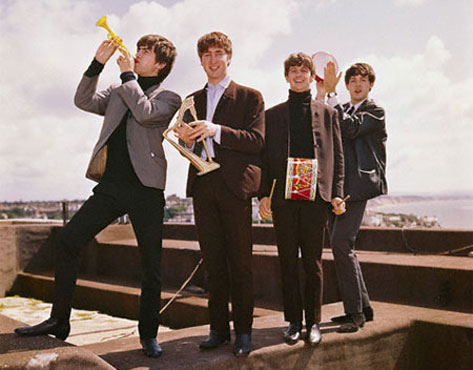
Avantgarde for the time, the original album had a fully laminated gatefold sleeve with lyrics printed on the back (for the first time on a rock album), a red and white ”psychedelic” inner sleeve and, inserted as a bonus, a cardboard sheet with several cut-out items. Packaged to attract attention in every way.
Since Sgt. Pepper was said to be the first ”concept album”, fan expectations must have been at an unimaginable level in the face of such a novelty. Provided that Paul McCartney’s idea of a fictional band (featuring the members’ alter egos) fits the description of a ”concept album”. John Lennon later stated that his compositions had nothing to do with the Sgt. Pepper concept. George Harrison was also not enthusiastic about McCartney’s idea, as he had recently fallen in love with Indian music during a visit there in the fall of 1966.
On the opening title track, written by Paul McCartney, a frantic lead guitar act as a catalyst. As icing on the cake, we get a voluminous and unforeseen brass arrangement. It’s not a sensational start that Paul offers, but those who were acquainted with the early Beatles realized that this was the beginning of something else.
Considering With a Little Help from My Friends, whose lyrics make Ringo Starr appear as a rather pathetic figure, the increasingly rare musical collaboration between Lennon and McCartney yielded excellent results. Less is more, and it goes without saying that the verses and bridge are clear-cut.
 According to Second Hand Songs, With a Little Help from My Friends has more than 400 cover versions, of which three (Joe Cocker, Wet Wet Wet and Sam & Mark) topped the UK charts. Most famous is of course Cocker’s total makeover.
The album continues its winning streak with Lennon at his best; like a sumptuous daydream, with lyrics inspired by the Alice in Wonderland books, flanked by a refined musical backdrop. With the help of a Lowrey organ and the string instrument tambura drone, the verses of Lucy in the Sky with Diamonds become a captivating hallucination, and the chorus almost as effective as ”We all live in a yellow submarine”.
Strikingly, two album tracks in a row would top the two most important charts as cover versions. It was Elton John who took Lucy in the Sky with Diamonds to number one on the Billboard Hot 100 in 1975.
So, I have no objections to the strong opening trilogy, but Sergeant Pepper is slowly demoted to Private Pepper …
I may be out on a limb, but my first inkling, half a minute into Paul’s Getting Better, is that he did so much better on Got to Get You into My Life from Revolver.
Both tracks are characterized by an ambitious tone in the opening, but when the repeat button gets stuck too early on Getting Better, Got to Get You into My Life, with its impeccable verses, reveals the difference between a brilliant and a skillfully written song. It is also involuntarily amusing to hear the well-behaved schoolboy Paul describe himself as a rebellious student and as a woman abuser, until it turns out that it is John who is guilty of the lyrics about abusing women.
Paul McCartney had a rare ability to write effective melodies, which occasionally crossed the line and became banal. On Fixing a Hole he stays on the right side, but the melody still doesn’t engage much. Also, during the psychedelic era, my first impression of the lyrics was that I had no desire whatsoever to hear contractor Paul McCartney working on his house, but it turns out the lyrics are ambiguous.
Before we move on to She’s Leaving Home – the third composition in a row signed by Paul McCartney – it might be appropriate to emphasize how John Lennon, The Beatles’ lead songwriter until 1966, had abdicated this throne.
Yes, we’re talking about the guy who wrote 10 of the 13 songs on the album A Hard Day’s Night and who delivered four consecutive A-sides to singles during 1964–1965. On the album Help! the score is 5–5 between the two giants, and even though Paul wrote Yesterday, John still feels like the winner. (Of course there are songs where neither John nor Paul have written one hundred percent each but did contribute to some extent.)
 As for Rubber Soul, it’s John’s tour de force, with several masterpieces. A buffet with brilliant melodies (Norwegian Wood and Nowhere Man) or carefully crafted creations (Girl and In My Life). Furthermore, I think that the musical qualities of the much-maligned Run for Your Life leave nothing to be desired, even if the sexist lyrics and the copy / paste from Baby Let’s Play House (”I’d rather see you dead, little girl, than to be with another man”) detract from the overall impression.
By the time the follow-up Revolver was released in August 1966 – an album that even surpassed Rubber Soul in taking pop music to new heights – Paul had taken the lead 6–5, but all of John’s contributions have a quality that very few songwriters are able to achieve.
After The Beatles played what turned out to be their last proper concert (in San Francisco on August 29, 1966), Lennon languished in his luxurious suburban mansion – trapped in an increasingly failing marriage, while his LSD trips became more frequent. When the former leader should have been out in Swinging London, finding inspiration, John chose to spend seven weeks in the Spanish desert filming the movie How I Won the War, despite only having a supporting role. Instead, it was Paul who was the man about town, including checking out the underground scene, and who wrote the music for the film The Family Way.
On Sgt. Pepper’s Lonely Hearts Club Band, Lennon has almost left walkover losing 3–6 (or 3–7, if you count the shorter version of the title track).
Yes, Paul McCartney pulled the strings at this point, but his songwriting talent is still absent to some degree on She’s Leaving Home. The orchestral arrangement really captivates me, but it feels like Paul’s also being somewhat conceited – like wanting to show the whole world how much he had progressed since 1962.
She’s Leaving Home certainly has some bright moments, and it’s also one of the better tracks on the album, but it simply lacks the magic pen compared to McCartney’s magnificent canon of songs in the same vein, such as And I Love Her (where the middle eight part is simply breathtaking, even though Lennon might have been involved to some extent), Yesterday, Eleanor Rigby, Here There and Everywhere and For No One. Those songs still affect me after some 50 years, while She’s Leaving Home feels deceptive in comparison.
I get the feeling that when the recording budget seemed to have no limits, The Beatles wanted to exploit every last drop of the arrangements with classical instruments. After the final mixing, it turned out that Sgt. Pepper had taken three times as long to record as Rubber Soul.
 John Lennon’s Being for the Benefit of Mr. Kite is unfortunately another example of when the paint starts to peel and the sound effects become most essential. The enveloping circus atmosphere must have attracted attention in 1967, but in 2025 it only feels like a far-out journey. If Lennon wanted to be an avant-garde composer, he succeeded better with Tomorrow Never Knows on Revolver, whose innovative production is always fascinating.
Today I consider Being for the Benefit of Mr. Kite as the track where producer George Martin wanted engineer Geoff Emerick to chop the tape into pieces with scissors, throw them up in the air, and re-assemble them at random.
The only advantage of putting George Harrison’s only contribution, Within You Without You, as the opening track on side two is that vinyl lovers can easily skip it …
Over the past eighteen months, George had gotten a grip on himself, delivering a total of seven compositions on Help!, Rubber Soul and Revolver. Since Harrison’s working schedule was patchy, just like the cream of the crop in the group, the result was still the worst track on Sgt. Pepper.
There’s an unintentionally comical incident from the 1971 Concert for Bangladesh, when Ravi Shankar plays the sitar to the cheers of the audience. Shankar, however, remarks: “Thank you. If you appreciate the tuning so much, I hope you’ll enjoy the playing more.” Maybe I’m too biased about this kind of music, but Within You Without You sounds like Harrison is tuning for five minutes.
Hardly surprising, Within You Without You is the track where opinions diverge the most; from being hailed as a masterpiece to being slaughtered with descriptions like ”directionless” and ”a prime example of mock philosophical babble”.
Sgt. Pepper’s Lonely Hearts Club Band could have been quite better if George’s composition Only a Northern Song (recorded at the same time) had been included instead. Sure, the song contains elements from his If I Needed Someone, but it still took another two years before Only a Northern Song saw the light of day on the Yellow Submarine soundtrack.
 What’s more, Harrison had already laid the groundwork for Isn’t It a Pity and Art of Dying in 1966 – two songs that appear on his classic triple album All Things Must Pass from 1970.
None of these tracks match the Harrison classics While My Guitar Gently Weeps, Something or Here Comes the Sun of course. But compared to Within You Without You, they all qualify as decent album tracks.
The reader has noticed my tendency to move backwards and forwards in time in this article. That’s because I find much better outcomes from these periods, and when it comes to George Harrison there are more examples. His first composition based on the sitar, Love You To (from Revolver), was better. This also applies to It’s All too Much (recorded around the same time Sgt. Pepper was released, later included on the soundtrack to Yellow Submarine), Blue Jay Way (from the EP Magical Mystery Tour) and The Inner Light (a single B-side, recorded in early 1968).
There is really no objection to the musical qualities of Paul McCartney’s When I’m Sixty-Four, but he wrote it back in 1956! Also, the melody feels out of place for a group that wanted to lead the musical revolution. Perhaps Paul wanted to appeal to the older generation and thus offer something for everyone?
 If Within You Without You is the album’s bleakest track, then McCartney’s Lovely Rita is its most clichéd counterpart. Seriously Paul, it’s 1967 after all, and you want The Beatles to take the lyrics into uncharted territory. Instead, we get a number about a meter-maid, set to a melody that could be the worst he has written since 1962.
Regarding John Lennon’s Good Morning Good Morning, one might think that someone at The Beatles’ music publishing house had introduced a new royalty rule: the more times the title is being sung, the more payment.
Good Morning Good Morning also leaves me unmoved, just like Being for the Benefit of Mr. Kite. The only thing that saves the song is the fiery bridge. Even Lennon didn’t like it: ”It’s a throwaway, a piece of garbage!”
Is this really the same guy who previously wrote A Hard Day’s Night, I Feel Fine, Ticket to Ride, Help!, Day Tripper, the aforementioned songs from Rubber Soul, Rain, And Your Bird Can Sing and Strawberry Fields Forever? Good Morning Good Morning is not a bad track, but it must still be considered a parenthesis in Lennon’s outstanding career.
We skip the short reprise of Sgt. Pepper’s Lonely Hearts Club Band and go straight to the acclaimed A Day in the Life. Well, there’s not really much to say, at least not when it comes to John Lennon’s part, and it’s no wonder that the composition often ends up in the top 10 lists of the best Beatles songs. On the other hand, McCartney’s part is not nearly as impressive, but the attention was of course drawn to the fact that they had put together two completely different contributions and got a working unit.
Just over a month before Sgt. Pepper’s Lonely Hearts Club Band was released, Paul recorded Magical Mystery Tour. The rousing composition could have been one of the highlights of Sgt. Pepper, albeit with different lyrics. A few months later, we had the privilege of hearing Macca at his best: The Fool On the Hill – a composition of superior quality compared to She’s Leaving Home, in my opinion.
 It is also significant that less than a month after Sgt. Pepper’s release, John Lennon gave us All You Need Is Love, featuring one of his better verse lines, and later that year he delivered the psychedelic masterpiece I Am the Walrus. In Lennon’s case, it may have been a combination of an increasingly chaotic personal life and too much drug intake that sapped his creativity.
A year later, after cleansing his body and soul in India, he had a host of worthy songs for what would become the White Album plus Across the Universe (the first version was recorded in February 1968) and Child of Nature (later known as Jealous Guy).
For many years Sgt. Pepper has ended up very high on Best Album lists – for instance All Time Top 1000 Albums [Colin Larkin, 1994] and the Rolling Stone magazine’s 500 Greatest Albums of All Time [2003]. (The Rolling Stone album list from 2023 reveals a significant change, though, where Sgt. Pepper has fallen to #24, but a lot has happened during 20 years and the survey was also done in a different way.)
So, what is my final conclusion? Well, I would probably give Sgt. Pepper’s Lonely Hearts Club Band a 7 out of 10. Two-thirds of the tracks are satisfactory and some of those songs are even better. The dilemma, however, is that several of them do not enchant me, as so many other Beatles songs have done since their second album With The Beatles was released in November 1963.
 I would even go as far as to say that only the debut album Please Please Me and the final album Let It Be get lower marks. Don’t get me wrong – I am a huge fan of The Beatles and I give most of their albums a 9 or 10.
The main problem with Sgt. Pepper is that John Lennon had lost the thread for a while, and that George Harrison should had pushed harder to get his better songs included.
Instead, Sgt. Pepper feels like an exercise in studio engineering. It must have been a dazzling experience to hear the album, especially the sound effects in 1967, but in the long run the end result is not nearly as impressive. The album even feels somewhat deceptive; it lacks heart and soul.
Imagine a teenager in 2025, who has just discovered The Beatles and classics like I Want to Hold Your Hand, A Hard Day’s Night and Help!, and who has since broadened the perspective with albums like Rubber Soul and Revolver. I seriously doubt that the same teenager would have embraced Sgt. Pepper’s Lonely Hearts Club Band in the same way, without having the same frame of reference as someone who was a teenager in 1967.
To those of you who have become angry – and there are probably a lot of you – I just want to say: do you really think Being for the Benefit of Mr. Kite, Within You Without You, Lovely Rita and Good Morning Good Morning live up to the standard we can expect, considering all the months the members have had to create lasting songs? No, I don’t think so. Yes, good craftsmanship but sans finesse and delicacy. Strawberry Fields Forever and Penny Lane were created by The Fab Four and Sgt. Pepper’s Lonely Hearts Club Band by The Fabric Four.
In a 1971 interview, John Lennon hit the nail on the head: ”I always preferred it (White Album) to all the other albums, including Pepper, because I thought the music was better. The Pepper myth is bigger, but the music on the White Album is far superior, I think. I wrote a lot of good stuff on that. I like all the stuff I did on that and the other stuff as well. I like the whole album.”
 Not many reviews from 1967 agree with me, even though there were a few that were not impressed. I’m not surprised, as critics were probably excited after the relatively long hiatus between Revolver and Sgt. Pepper’s Lonely Hearts Club Band and the whole inventive package, before they even let the needle land.
It wasn’t just the packaging and musical aspect that made Sgt. Pepper so legendary. The album was considered by some to be one of the few times the Western world was united. It also managed to bridge the generation gap that had existed since Elvis Presley entered the scene with Heartbreak Hotel eleven years earlier. Mark Lewisohn even wrote in his book The Complete Beatles Chronicle [Pyramid Books, 1992]: ”It was as if The Beatles were suddenly stepping out of black-and-white and into full-blown, glorious colour.”
But it took only a year for that colourful paint to peel off, when Martin Luther King and Robert Kennedy were assassinated. The final blow to The Swingin’ Sixties and The Summer of Love was the tragedy at the Altamont Free Festival in December 1969.
The aftermath of Sgt. Pepper’s Lonely Hearts Club Band was mixed. For the first time, albums became a more important format than singles, at least in a musical context, and artists were allowed more studio time.
Perhaps Sgt. Pepper provided a template for groundbreaking albums like Forever Changes (Love), Days of Future Passed (The Moody Blues) and Odessey and Oracle (The Zombies) or self-indulgent albums like Their Satanic Majesties Request (The Rolling Stones) and After Bathing at Baxter’s (Jefferson Airplane). The latter album took considerably longer to record than Sgt. Pepper – a sign that Jefferson Airplane had caught the Pepper virus.
Those who don’t appreciate progressive rock like Yes and Emerson Lake & Palmer, can blame the legendary May 1967 album for suffering through the first half of the 1970s, before punk and new wave arrived as a savior.
 That is also emphasized by Elijah Wald’s book How The Beatles Destroyed Rock ’n’ Roll: An Alternative History of American Popular Music [Oxford University Press, 2009], where he claims, among other things, that the pop scene was bifurcating – rock was increasingly meant for listening rather than dancing (more and more people started sitting down during concerts) and that black and white styles were diverging (according to New York Times, Wald suggests that The Beatles ambitious later work – now the group made music that they couldn’t perform live, even if they wanted to – widely hailed as a step forward for rock, instead helped turn it from a triumphantly mongrel dance music that smashed racial barriers into a rhythmically inert art music made mostly by and for white people).
I should mention that Elijah Wald never says a bad word about The Beatles but urges us to look critically at the way culture reacted to the group and what came after. The chapters on The Beatles, and especially on the world after the group, are also a relatively small part of the book.
For those of you who think I’m narrow-minded and only appreciate pop music with catchy melodies, I still find The Moody Blues’ albums between 1967 and 1972 and Wishbone Ash’s Argus from 1972 act as exciting musical journeys. Also, Television’s debut album Marquee Moon, released five years later, has been a favourite for many years – not the most accessible album.
You’ll remember that I mentioned Love’s Forever Changes – an album that offers dazzling beauty and epic parts, surrounded by multi-coloured arrangements.
If you’re still not convinced about the pros and cons of Sgt. Pepper, then in my opinion the mediocre quality of some of the songs means that the cons outweigh the pros.
 I think Ian MacDonald, author of the classic book Revolution in the Head [Fourth Estate, 1994], also hits the nail on the head, when he writes about the title track:
”As a song, like many of the Sgt. Pepper tracks, this is clearly inferior to the average number on Revolver, yet the comparison is unfair. Different in scope, the later album demands to be taken as a whole, and in that perspective Sgt. Pepper’s Lonely Hearts Club Band serves its purpose well. Moreover, for the group, content was becoming more important than form. Sgt. Pepper surpasses Revolver, not in form but in spirit.”

Thanks to Peter Jönsson for substantial language editing.

Be the first to comment